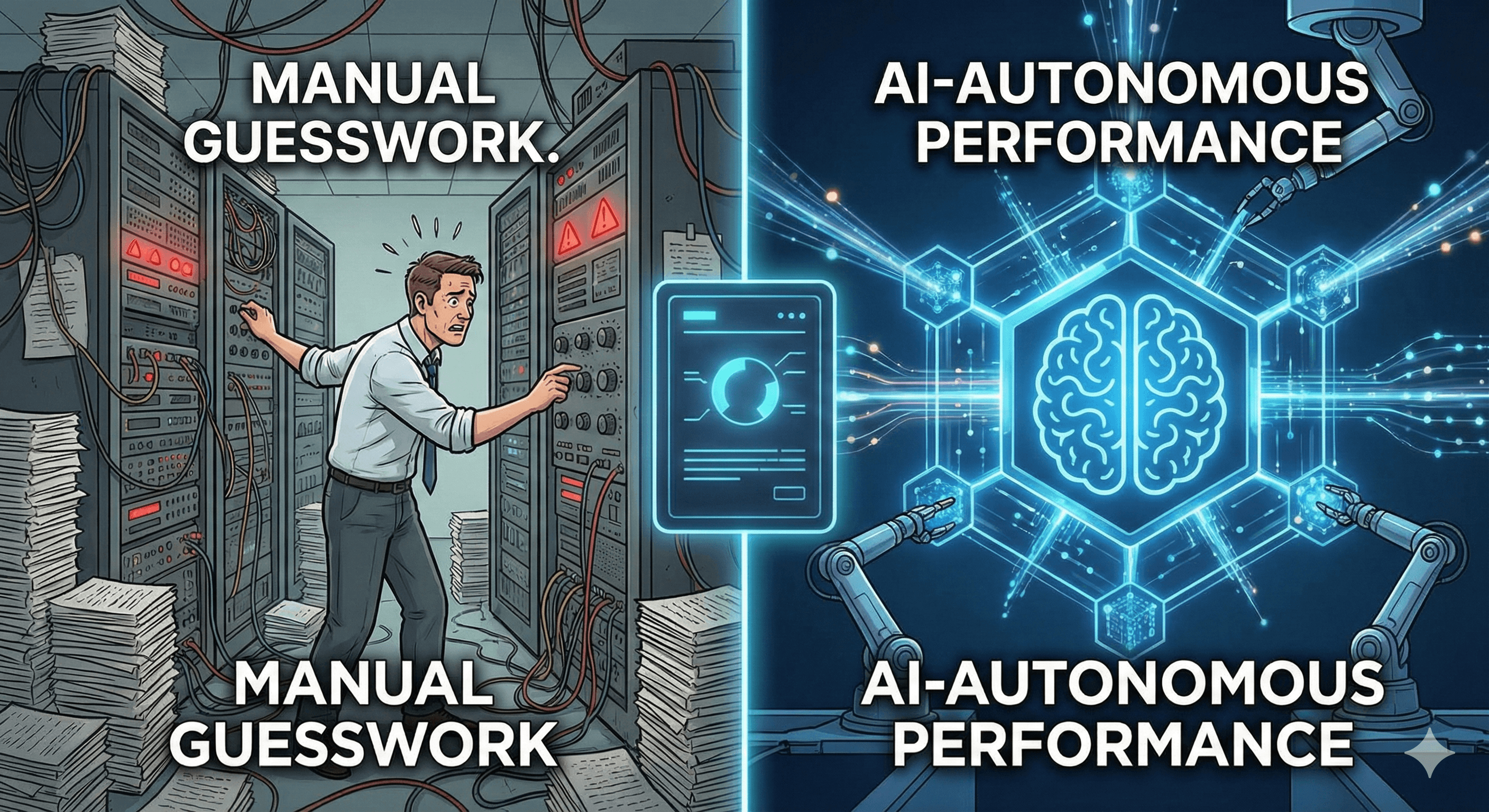
How AI is Autonomizing Database Performance
For decades, database performance was considered a dark art. It was the domain of grizzled DBAs who could intuitively read `EXPLAIN` plans, spot missing indexes by feel, and knew exactly which obscure configuration knob to turn when CPU usage spiked at 3 AM.
But in the era of microservices, massive data velocity, and continuous deployment, the "manual tuning" model is breaking down. Human DBAs cannot scale linearly with the data they manage.
Fortunately, they no longer have to.
The convergence of next-gen developer tools and artificial intelligence is fundamentally rewriting the rules of data management. We are moving from reactive, manual database administration to proactive, AI-assisted data engineering. Here is how AI is transforming the database stack across administration, development, and optimization.
1. The End of "Guesswork" Indexing Strategies
Traditionally, indexing was a reactive game. An application would slow down, a DBA would analyze weeks of slow query logs, identify a bottleneck, add an index, and hope it didn't negatively impact write performance. It was an educated guess loop.
The AI Paradigm Shift: Modern autonomous database systems and external AI tuning tools have turned indexing into an empirical, real-time science.
AI agents now monitor actual workload patterns continuously. They don't just spot slow queries; they analyze entire query chains to understand *how* data is being accessed. Based on this data, these systems can:
Automatically Recommend Indexes: Suggesting the perfect composite index based on real-world `WHERE` clauses and `JOIN` conditions.
Self-Healing Implementation: In some autonomous cloud databases, the system can apply the index automatically during low-traffic periods, test the performance impact, and roll it back instantly if things get worse.
Identifying "Index Bloat": Crucially, AI also identifies unused or redundant indexes that are slowing down write operations and wasting storage, suggesting their removal.
The Impact: Indexing shifts from a quarterly maintenance task to a continuous, self-optimizing background process.
2. Intelligent Query Engineering (Before it Hits Production)
The most expensive time to fix a bad query is after it has crashed production. Historically, developers—often abstracted away from the underlying database by ORMs (Object-Relational Mapping)—would inadvertently write inefficient code like N+1 query problems or cartesian products.
The AI Paradigm Shift: Next-gen developer tools (like Cursor, GitHub Copilot, and specialized SQL AI assistants) are moving performance engineering "left"—right into the IDE.
AI is now context-aware enough to understand the relationship between your application code (Python, Java, Node.js) and your database schema.
Real-Time Anti-Pattern Detection: As a developer types an ORM query, the AI assistant can flag it: *"Warning: This loop will generate 500 separate database calls. Consider eager-loading this relationship instead."*
Natural Language to Optimized SQL: Instead of struggling with complex window functions, developers can prompt an AI: *"Write a query to find the rolling 3-day average sales per region, optimized for a PostgreSQL redshift."* The AI generates highly performant SQL syntax that might take a human hours to craft.
Automated Refactoring: AI tools can scan legacy codebases, identify massive, monolithic stored procedures, and suggest ways to break them down or rewrite them for modern query engines.
3. From Monitoring Dashboards to Proactive Observability
The old way of monitoring was staring at dashboards full of squiggly lines, waiting for CPU or memory to hit a red threshold. It told you what was happening, but rarely why.
The AI Paradigm Shift: AI-driven observability platforms are moving past static thresholds and into anomaly detection and root cause analysis.
Instead of alerting you that "DB CPU is at 90%," an AI-enhanced system alerts you with context:
"Anomaly Detected: Database CPU spiked at 10:05 AM. This correlates with Deployment v2.3. The root cause appears to be a new un-indexed query introduced in the 'UserDashboard' component scanning the 'TransactionHistory' table full-scan."
By correlating deployment events, application logs, and database metrics, AI slashes the Mean Time To Recovery (MTTR) from hours of investigation to minutes of verification.
The New Role of the Data Professional
Does this mean the end of the DBA or Data Engineer? absolutely not.
Just as autopilot didn't replace pilots, AI isn't replacing database professionals—it is elevating them. When you stop spending your days manually tweaking memory buffers or hunting down missing indexes, you free up time for high-value architectural work:
Designing robust data models that scale.
Implementing complex data governance and security strategies.
Architecting multi-region data meshes for global availability.
The future of database performance isn't about knowing which knob to turn. It's about knowing which AI tools to trust to turn the knobs for you.